Fahraj Village, based on the criteria of attraction, infrastructure, value chain, and village sustainability, has been selected with the 2nd national ranking as one of Iran’s 8 candidates for the “Best Tourism Villages” project of 2024, to be introduced to the World Tourism Organization.
** میراث آریا (Mirath Arya News Agency):** Accordingly, we will briefly introduce this village, its prominent features, and examine the selection process of the village as one of Iran’s eight candidates in the “Best Tourism Villages” project of 2024.
Historical Background:
The history of the historical village of Fahraj in Yazd dates back to the pre-Islamic era, and some believe that this village is over 8,000 years old. In ancient times, Fahraj Yazd was the gateway to Isatis and one of the four important and main parts of the old historical city of Yazd.
Until the eighth century AH (Islamic calendar), this village was known as one of the important cities of Yazd, and Ibn Balkhi, in his descriptions of this city, mentions its significant agricultural standing.
Reasons for the Village’s Emergence and Etymology:
The old city of Fahraj was called Farafar, meaning “pleasant climate,” and has an 8,000-year history. Later, its name became “Par Hasht,” referring to its route from the Fahraj Martyrs Complex to near the old city’s railway, which was submerged by a flood 5,000 years ago.
In Sasanian Pahlavi, Fahraj was called “Pahreh,” related to the Persian words “Pehresht,” “Pahleh,” and “Fahleh,” meaning city, gathering place, house, and settlement. After the Islamic conquest of this city, “Pahreh” was adopted and transformed into “Fahraj.”
Fahraj has been identified, studied, and implemented as a valuable historical texture. This area covers 173,654.5 square meters.
Village Location:
Fahraj village is located in the southeast of Yazd city on the Bafq-Yazd highway, in Fahraj district. Situated at an altitude of 1,270 meters above sea level, it is bordered by Chehelteh Mountain to the northeast. The distance from Fahraj village to Yazd is approximately 33 kilometers (40 minutes), and to Bafq is about 88 kilometers (one hour).
Access to Fahraj village in Yazd is very easy. The village is located on the right side of the Yazd-Bafq road.
Existing Village Facilities:
Suitable access roads, appropriate rural tourism infrastructure, organization of village tourism routes and axes (signage, restrooms, implementation of the master plan based on cultural heritage regulations, etc.), establishment of two ecotourism parks, and the active presence of several ecotourism accommodations are among the most important facilities of the active and dynamic village of Fahraj.
Fahraj, with its exporting greenhouses of vegetables, green peppers, and spiky cucumbers, is among the villages that export agricultural products to target markets.
Souvenirs and Handicrafts:
Carpet weaving and work on exquisite fabrics (such as Termeh) are prevalent in this village. Given the long-standing reputation of Yazd province in Sha’rbafi (weaving and production of handwoven cotton and zari fabrics, and Karbafi weaving), Fahraj village can serve as a market and center for establishing handicraft workshops and an eco-museum to showcase the production process from raw materials to finished products (green health textiles) and work on precious fabrics.
The most important local dishes of Fahraj village include Eshkeneh, Kaleh Joosh, Shooli, Ghormeh, Sorook, Sholeh Zard, and more.
Socio-Cultural Features Attractive to Tourists, Including Traditions:
The people of Fahraj village in Yazd adhere to Shia Islam, and religious ceremonies are held there every year. During Ashura, the villagers perform the traditional Nakhl Bardari (carrying the symbolic coffin) and Nakhl Gardani (circling the symbolic coffin) rituals, which have their own special attraction.
The Heydari Fahraj ceremony is one of the customs held in this village and is registered on the National List of Intangible Cultural Heritage.
Festivals:
Bicycle Festival: Fahraj village is known as the “Land of Ancient Bicycles,” and a cycling event is held every year during Nowruz (Persian New Year). So far, 17 cycling events have been held in the village.
Akhavan Sales Commemoration Ceremony: In 2022, on the occasion of the Prophet Muhammad’s (PBUH) ascension and the birth anniversary of Mehdi Akhavan Sales, the renowned Iranian poet, a poetry night was held in Fahraj with a group of Yazdi poets, and his son, Ali Akhavan Sales, also participated.
It is worth noting that the ancestral home of Mehdi Akhavan Sales, the famous Iranian poet and a native of Fahraj, is located on the south side of the Jameh Mosque of Fahraj.
Architecture of Fahraj Village:
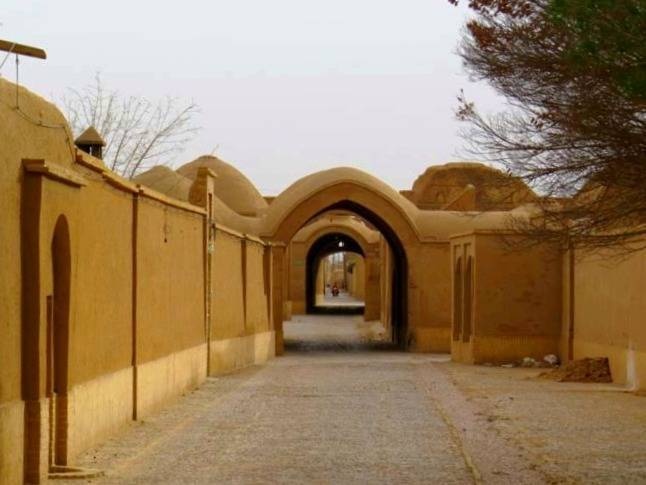
Like other settlements in the desert province of Yazd, most of the houses and structures in Fahraj village are built with the traditional architecture of the tropical and desert regions of Iran. In fact, two different architectural textures are seen in Fahraj village: the old texture of the village, located around the Jameh Mosque in the heart of Fahraj, in a semi-clustered and linear form, and the modern texture of the village, which extends around the old texture and surrounds the ancient structures of the village. The houses in this village are generally made of adobe, mud, and brick, and some of them, with their windcatchers atop their roofs, have well-preserved their historical authenticity. As you walk through the narrow alleys of this village, you will see semi-covered passages called Sabat (Sabat), which not only enhance the architectural beauty of the town with their unique design but also significantly reduce the intensity of the heat by providing shade for pedestrians.
Tourist Attractions and Historical Sites of Fahraj Village, Yazd:
Fahraj village in Yazd has numerous tourist attractions and historical sites, some of which are introduced below:
Jameh Mosque of Fahraj, Fahraj Martyrs Historical Complex, Hosseiniyeh Cistern, Fahraj Fortress, Alaghabandi or Ali Ghavandi Mosque (only beautiful stucco work remains of this mosque), Chehel Dokhtaran Well… are the most important historical sites of the village.
Jameh Mosque of Fahraj: This mosque is considered one of the oldest mosques in Iran, with its construction dating back to the first century AH (Islamic calendar). According to existing documents, it is likely that the Jameh Mosque of Fahraj was built after the arrival of Islam in Iran.
Based on existing documents, the construction of the Jameh Mosque of Fahraj dates back to the first half of the first century AH, but the main building was originally a Sasanian-era structure that was converted into a mosque with the arrival of Islam, during the caliphate of Umar.
Ancient Fortress of Fahraj: The initial construction of the historical Fahraj Fortress also dates back to the same period as those buildings, but the current facade and its decorations belong to the tenth and eleventh centuries AH. The Fahraj Fortress has a quadrilateral plan with four circular towers at its four corners. The towers have two floors, and all existing structures have groin vaults with pointed arches. Above the walls, holes are embedded, likely used for observation. Fahraj Fortress was registered on the National List of Monuments with registration number 29987, dated November 7, 2010.
Hosseiniyeh Cistern of Fahraj: Another historical site in Fahraj is the Hosseiniyeh Cistern of Fahraj. This place has a long history, and although experts attribute it to the Safavid era, many archaeologists date its construction to the pre-Islamic period.
In very ancient times, this place was used for holding events such as water consecration ceremonies. Today, this place is considered one of the best tourist attractions in Yazd and is ready to showcase a part of our country’s rich history to visitors.
Chehel Dokhtaran Well (Well of Forty Daughters): Another tourist attraction of Fahraj village, which holds a dark and tragic history, is the Chehel Dokhtaran Well. According to the narrations of the residents of this area, the reason for naming this attraction “Forty Daughters” is the suicide of forty girls during an invasion of this region of our country. It is said that after the invaders attacked this area, the girls, seeing the enemy soldiers behind them, chose death to protect their honor and dignity and threw themselves one by one into the well.
Fahraj Martyrs Historical Complex: Belonging to the ninth century AH, it is located thirty kilometers northeast of Yazd city and in Fahraj village. This complex consists of a tomb, a school, and a Khaneghah (Sufi lodge) and was registered as one of Iran’s national monuments with registration number 2444 on November 9, 1999.
Three Significant and Notable Initiatives and Characteristics in Fahraj Village:
Lantern of the Desert (Fanoos Kavir): In the past, merchants traveling through the central desert of Iran went to Fahraj village to find a resting place, which is why this village became known as the “Lantern of the Desert.” In this village, there has been a building called “Gharib Khaneh” (Stranger’s House) since ancient times, which was intended for travelers to stay, and it can be considered one of the first models of hospitality in Iran. The ecotourism accommodations in Fahraj have been modeled after these Gharib Khanehs. This village, as in the past, is a village friendly to strangers and tourists and, with its old texture, has become a place for tourists to visit.
Development of Agricultural Tourism: Fahraj village is one of the agricultural and greenhouse hubs, with 700 hectares of orchards, 300 hectares of export-oriented vegetables, and 400 hectares of arable crops, operating based on optimal efficiency, water and solar energy consumption, and technology localization. The people of this village, utilizing these capacities, have turned Fahraj into a hub for agricultural tourism. The fencing around farms and livestock breeding centers is in accordance with the architecture and texture of the village. The agricultural tourism of the villagers operates based on local employment and the participation of the village women.
Development of Desert and Wilderness Tourism: The desert and wilderness are among the beauties of Fahraj village. Understanding these capacities, the villagers have taken steps to develop desert and wilderness tourism. They have created two nature tourism parks with a focus on sustainable development and the participation of local people. These nature tourism parks are among the new models in Iran’s ecotourism development, and the villagers are active in this field. These parks offer tourism activities such as safari, camel riding, local food, stargazing, scientific and educational activities, camping, etc., which have been well-received by tourists.
Fahraj on the Path to Being Included in the List of Global Villages:
The fourth competition for the selection of the “Best Tourism Villages” in 2024 includes eight candidate villages from Iran: Isfahak, Palangan, Abyaneh, Fahraj, Qaleh Bala, Kandolos, Bisheh, and Meymand.
Village Selection Process and Actions Taken in This Regard:
Considering the assessments carried out by experts from the Ministry of Cultural Heritage, Tourism, and Handicrafts based on the criteria of attraction, infrastructure, value chain, and village sustainability, Fahraj, with the 2nd national ranking, was selected as one of the eight candidates in the “Best Tourism Villages” project of 2024 for introduction to the World Tourism Organization.
So far, brainstorming sessions and efforts to remove existing obstacles for the membership of the Fahraj tourism target village in the Global Network of Creative Villages have been held. Additionally, three special steering committees have been formed with the presence of provincial and village officials, as well as assessors from the central headquarters of the Ministry of Cultural Heritage, Tourism, and Handicrafts, to complete the global dossier for the tourism village of Fahraj (Pahreh). These committees have reviewed and issued special orders for immediate action on the emergency restoration of historical buildings, especially the historical fortress, the organization of village restrooms and tourism routes and axes, the launch of the village website, the installation of signs, the establishment of a handicraft market and workshops, the training of local communities, the preparation of clips and photos of the village’s attractions and initiatives, the holding of rural events and festivals, especially in the agricultural tourism sector, and other related matters. The aim is to overcome the infrastructure obstacles in the village so that, with the efforts of all managers and responsible institutions, we will witness the registration of the global village of Fahraj.
Report by Najmeh Misagh, Public Relations Expert of the General Directorate of Cultural Heritage, Tourism, and Handicrafts of Yazd.