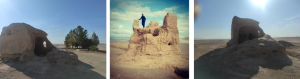
The history of Fahraj village in Yazd dates back to the pre-Islamic era, with some believing it to be over five thousand years old. In ancient times, Fahraj was the gateway to Isatis and one of the four important and main districts of the old historical city of Yazd. Until the eighth century AH (Islamic calendar), this village was considered one of the important cities of Yazd, and Ibn Balkhi, in his descriptions of this city, mentions its significant agricultural standing.
It is stated that Fahraj was built during the Sasanian dynasty, situated on the ancient route from Ray to Kerman, on the border of that province, and alongside a waterway called Mazvar. This stream originated from the foothills of a mountain south of Mehriz and, after traversing the Mehriz plain, flowed into a larger waterway called Sakzeh near Fahraj. This Sasanian king also built a town near Meybod called Haftad and erected a large fire temple there, subsequently ordering the construction of Fahraj and Heraft.
One of the most significant events in the history of Fahraj village is the arrival of the Islamic army. These soldiers, in pursuit of Yazdegerd III, the last Sasanian king, split into two groups to capture him. One of these groups got lost in the desert and eventually reached Fahraj village. According to some historical sources, those who intended to convert the people of various regions to Islam gave the Zoroastrian inhabitants of this village the choice to convert to Islam or pay tribute to the Islamic government; otherwise, they would face war with their army.
The people of Fahraj asked the soldiers for a respite to consult with two nearby villages and announce their decision the following day. After consulting with the village of “Herafteh” and the Jewish-populated village of “Khoveydak,” they ultimately decided to launch a night attack on the Islamic army. They attacked the army that night and killed some of them; the slain whose tombs can still be seen in the Fahraj Martyrs’ Shrine.
In the book “Yadgarhay-e Yazd” (Memoirs of Yazd) by Iraj Afshar, this event is described as follows:
The residents of Fahraj, Khoveydak, and Faraftar were Magians (Zoroastrians and Jews). During the time of Umar ibn al-Khattab, when the Islamic army, by his command, was going to Khorasan in pursuit of Yazdegerd Shahriyar… they lost their way among the sand dunes in the Tabas desert. After much wandering and hardship, they emerged from the sand dunes in the vicinity of Fahraj and invited the people of Fahraj to Islam. That group asked for time and provided provisions and fodder, sending them out. They summoned the people of Khoveydak and Faraftar and consulted with them, but they refused to accept Islam, saying, “We will not turn away from our ancient religion.” They all agreed and launched a night attack on the Islamic army, martyring many companions and followers, such as Huytayb ibn Hani, the nephew of Imam Ali (AS).
During the caliphate of Uthman, the third caliph, an army under the command of his son Saeed and Qutham ibn Abbas was dispatched towards Nishapur. After conquering Yazd, they marched towards Fahraj and conquered that city as well. The people of this city converted to Islam, and it was from then on that “Pahreh” was Arabized and became “Fahraj,” the name by which it is known to this day.
The use of the name Fahraj by geographers in the early Islamic centuries testifies to the political importance and centrality of Fahraj at that time. In particular, Istakhri introduced Fahraj as one of the three locations with a Friday mosque in the Yazd region.
Considering that in the early Islamic centuries in Iran, the term “city” was applied to those residential complexes that had a Friday mosque, it can be understood that Fahraj was a prosperous city a thousand years ago. However, over time and gradually, for reasons unknown in historical books, it lost its centrality and اعتبار (prestige/importance) as one of the four cities in this region. With its numerous historical relics from the Achaemenid, Parthian, and Sasanian periods, Fahraj is a treasure trove of Iran’s glory and grandeur and is considered one of the historical settlements.
.