According to IRNA, it was just a few months ago that news of “Yazd’s Fahraj Village Among the Top Eight Iranian Villages Nominated for Global Tourism Village” was published in the media, suddenly drawing attention in Yazd province towards this village.
The historical village of Fahraj has a long history, with historians attributing its antiquity to the pre-Islamic era. Although I had visited this village several times, this news prompted me to go there again to prepare a report and see what features set this desert village apart among the thousands of villages worldwide.
Moving southeast from the center of Yazd city, after passing through the villages of Mohammadabad, Ahmadabad-e Moshir, and Khoveydak on the Yazd-Bafq road, you reach the historical village of Fahraj. About a year had passed since my last visit to this village. After this time, the atmosphere of the historical texture of this village had undergone significant changes compared to what I had seen a year ago. Change is not the right word! I should say that Fahraj village has now become a different village, befitting its history and culture.
Why the Lantern of the Desert?
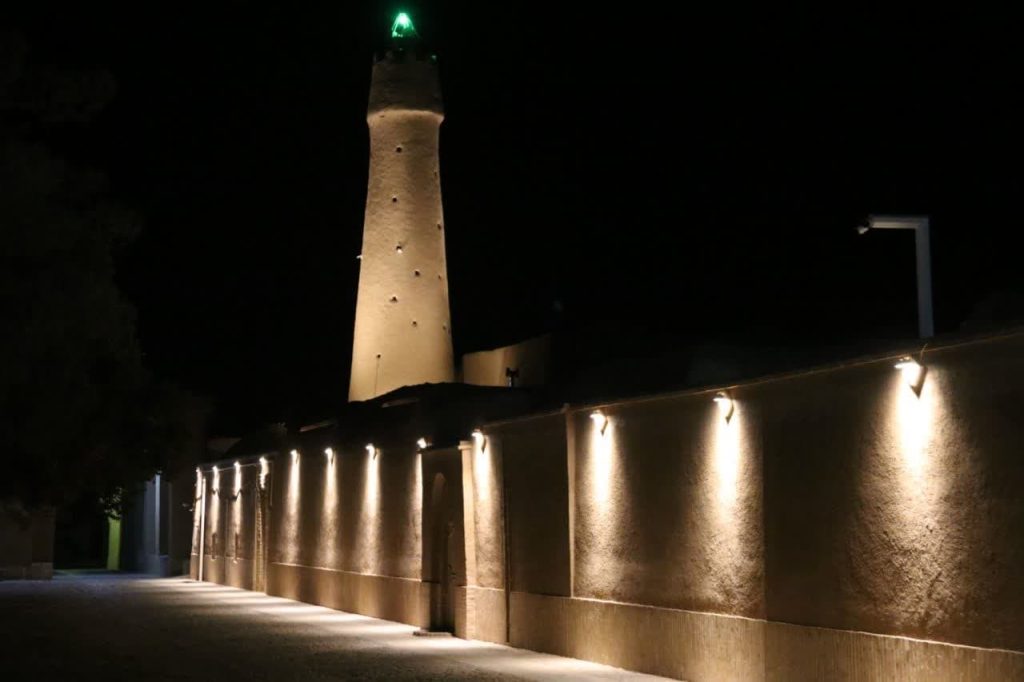
The first thing that always caught my attention upon entering this village was the tall, solitary adobe minaret adjacent to the Jameh Mosque of Fahraj. In the past, merchants traveling along their route in the central desert of Iran would stop and rest in Fahraj village, and this single minaret, like a lighthouse tower, served as a landmark for travelers to reach Fahraj on their desert journey.
Next to this adobe minaret resembling a lighthouse tower stands the Jameh Mosque of Fahraj. In addition to the adobe minaret, this mosque has eight large pillars, a small prayer hall, and two altars. Archaeological studies indicate that its construction dates back to the end of the Sasanian period and the beginning of the Islamic era. The construction of this mosque lacks modern elements such as inscriptions, tilework, or special decorations, and it even lacks a dome, which distinguishes its appearance from other mosques with Islamic architecture.
“Najmeh Naderi” is the supervisor of the restoration and organization of the historical village of Fahraj in Yazd, and we met at the Jameh Mosque of this village. While walking through the mosque, she explained the construction work carried out in this place and said: “To prevent damage to the valuable walls of this mosque, the walls have been protected with glass, and its roof has been re-covered with mud plaster to prevent damage during rainfall.”
She, who has been working full-time in Fahraj village of Yazd for the past few months overseeing construction and infrastructure operations, added: “When we came to this village, the mud-plastered walls had collapsed, and the gutters were destroyed. But now, with new mud plaster on the walls and the repair of the gutters, this structure is secured against damage for the next 45 years.”
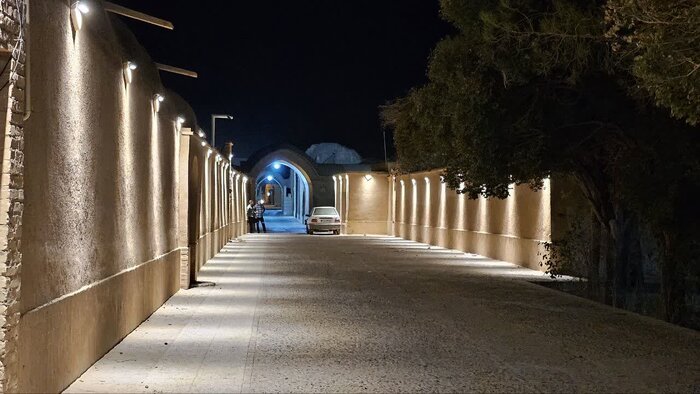
Together with Ms. Naderi, we walked from the Jameh Mosque of Fahraj towards a historical tourist route that had been beautifully restored with paving. She stated that measures have been taken in the historical texture of Fahraj village in Yazd to increase security at night, continuing: “In addition to installing cameras along the tourist route, lighting has also been installed for illumination and increased security at night, giving a special beauty to this route.”
Fahraj, an Accessible Tourism Village for People with Disabilities in Yazd.
Among the several hundred villages in Yazd province, only 39 are designated as tourism target villages. Among these, Fahraj stands out as perhaps the only village whose tourism route has been fully adapted and made accessible for people with disabilities and the elderly.
In this regard, I spoke with “Reza Abahat,” the Director-General of the Welfare Organization of Yazd Province, who had come to Fahraj village with a group of people with disabilities and the elderly. He stated that the population of people with disabilities in Yazd province is over 32,000 and added: “So far, half of the tourist and historical sites in Yazd province have been adapted for the use of people with disabilities and the elderly, and Fahraj is one of the few villages whose tourism route is fully accessible for this segment of the population.”
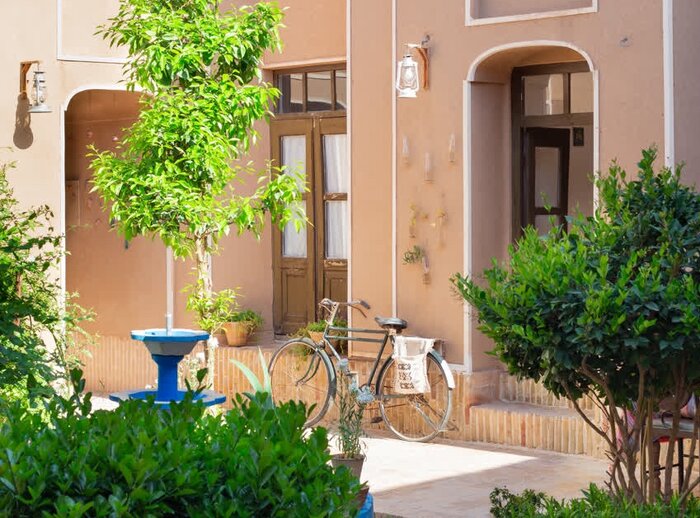
Abahat emphasized that all people with disabilities and the elderly in the province, as well as tourists who travel to this village, have the full right to use these spaces. He said: “From the entrance of the most beautiful and oldest building in this village, the Jameh Mosque of Fahraj, to the ecotourism accommodations located at the end of the tourism route, the area has been adapted and made accessible for people with disabilities. It can be said that Fahraj village is one of the destinations for ‘accessible tourism’ and is friendly to people with disabilities and the elderly in Yazd province.”
From Food Tourism to Agricultural Tourism in Fahraj.
Continuing my exploration of Fahraj village in Yazd, I also spoke with Ms. Bagheri under the traditional market of this village. She, along with a group of women from the village, was busy cooking traditional dishes of the region to welcome their guests.
Ms. Bagheri pointed to the “Goor Mast” dish she was holding and said: “The method of cooking this dish for Fahraj village was registered on the National List of Intangible Cultural Heritage a few weeks ago. In Fahraj, Goor Mast is prepared by boiling sheep’s milk and adding pomegranate juice to lukewarm milk, and it is eaten with traditional bread, mostly in late summer and early autumn.”
While explaining how to cook other traditional dishes of this village, she added: “‘Khoresh-e Beh Aloo’ (quince and plum stew), ‘Kashk-o-Kamach’ (whey and cumin bread crumbs), and ‘Shooli-e Shir’ (milk and vegetable soup) are other traditional dishes of Fahraj, the ingredients for which are mostly prepared traditionally and within this very village.”
Reaching the end of the small market with Ms. Bagheri, she explained that many handicrafts have been produced in Fahraj village from the past until today, continuing: “Soap making,” “Sefidab (traditional cosmetic) production,” “Sha’rbafi (traditional textile weaving),” “carpet weaving,” and “Espand Bafi (wild rue weaving)” are among the village’s handicrafts, mostly produced by women.”
Fahraj has long faced water scarcity, and the ancestors of this region brought water to the village through underground tunnels by digging qanats. Today, with the development of low-water-demand agriculture, it has become one of the export hubs for agricultural products and greenhouses, operating based on efficient water and solar energy consumption and technology localization.
In addition to greenhouse production, a “camel breeding farm” is another source of income for the village. Tourists can visit this complex, the greenhouses, and the farms, and agricultural tourism tours have also been developed in Fahraj village.
Preserving Nature Through Desert Tourism.
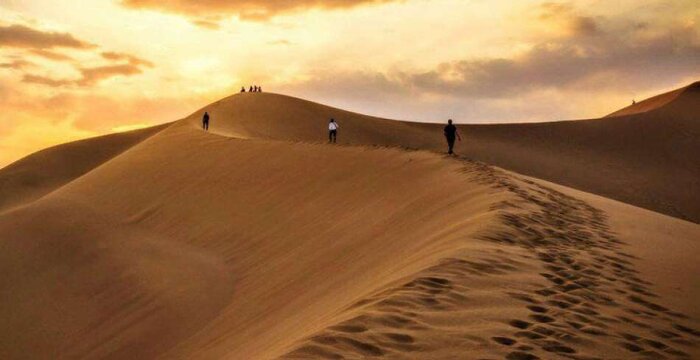
The desert and wilderness are among the beauties of Fahraj village in Yazd. Understanding these potentials, the villagers have taken steps to develop desert and wilderness tourism, and now two nature tourism parks located five kilometers from the village attract many tourists to Fahraj.
These two desert nature tourism parks have been established with a focus on sustainable development and the participation of local people. They are among Iran’s modern models in the field of ecotourism development, offering tourism activities such as “safari,” “camel riding,” “local food provision,” “stargazing,” “scientific and educational activities,” and “camping.”
Creation of Fahraj Village Website, Translatable into 11 Global Languages.
The village’s dedicated website and online portal were among the aspects being evaluated. This led to the launch of the website at (yazdfahraj.com). “Ahmad Fazeli,” the director of the Smart Tourism Center, which also manages the Fahraj village website, told IRNA: “The Fahraj website is equipped with artificial intelligence and can be simultaneously translated into 11 languages: Persian, English, Arabic, German, Chinese, Russian, Portuguese, Spanish, French, Dutch, and Italian.”
Fazeli provided more details about the website’s features, adding: “On the Fahraj village website, in addition to village news, visitors can view and read about historical and tourist attractions, architecture, culture, customs, prominent figures of the village. In a section titled ‘On the Path to Globalization,’ the plans made in this regard and Fahraj’s roadmap in the areas of construction and culture are updated daily.”
Less Than a Month Until the Selection of the Best Global Tourism Villages.
In 2024, in addition to the historical village of “Fahraj Yazd,” the dossiers of seven other villages – Palangan in Kurdistan, Bisheh in Lorestan, Qaleh Bala in Semnan, Kandolos in Mazandaran, Esfahak in South Khorasan, Meymand in Kerman, and Abyaneh in Isfahan – were sent to the World Tourism Organization as Iran’s representatives in the selection of global villages.
To learn about the selection process for the Global Tourism Village, I spoke with the Director-General of Domestic Tourism at the Ministry of Cultural Heritage, Tourism, and Handicrafts, “Mostafa Fatemi.” He said: “The diversity and multiplicity of Iran’s rural fabric, along with its breathtaking beauty, has made the selection of villages difficult. To choose the candidates, information on tourism target villages, categorized through a project by the University of Tehran, was received. After gathering the opinions of provincial departments and visits by the assessment team and rural tourism experts, including the Municipalities and Village Councils Organization of the Ministry of Interior, the Vice Presidency for Rural Development, the Ecotourism Accommodation Association, the Housing Foundation, and the Alavi Foundation, the nominated villages for the Global Tourism Village from Iran were introduced.”
Fatemi continued: “The World Tourism Organization has considered more than 40 indicators for selecting the best villages, ranging from the tourism value chain and accommodation, financial, and electronic infrastructure to a sustainable development perspective and the preservation of indigenous culture and the environment. However, the most important part of the dossier is the village’s initiatives and the impact of tourism on the village’s sustainability.”
The Director-General of Domestic Tourism at the Ministry of Cultural Heritage, Tourism, and Handicrafts, stating that in a tough competition, 50 top villages will be selected from about 1,500 candidates worldwide, added: “Given the limited number of selections, we hope for the final selection of at least one village, although under the current circumstances and infrastructure limitations resulting from sanctions, there is also a possibility of not succeeding in the final selection.”
The best global tourism villages will be announced on November 16th (of the Iranian calendar year, corresponding to November 25th, 2024) at the 122nd Executive Council of the United Nations World Tourism Organization in Cartagena de Indias, Colombia, and Iran is participating in this global competition with eight nominees, including the historical village of Fahraj in Yazd.