
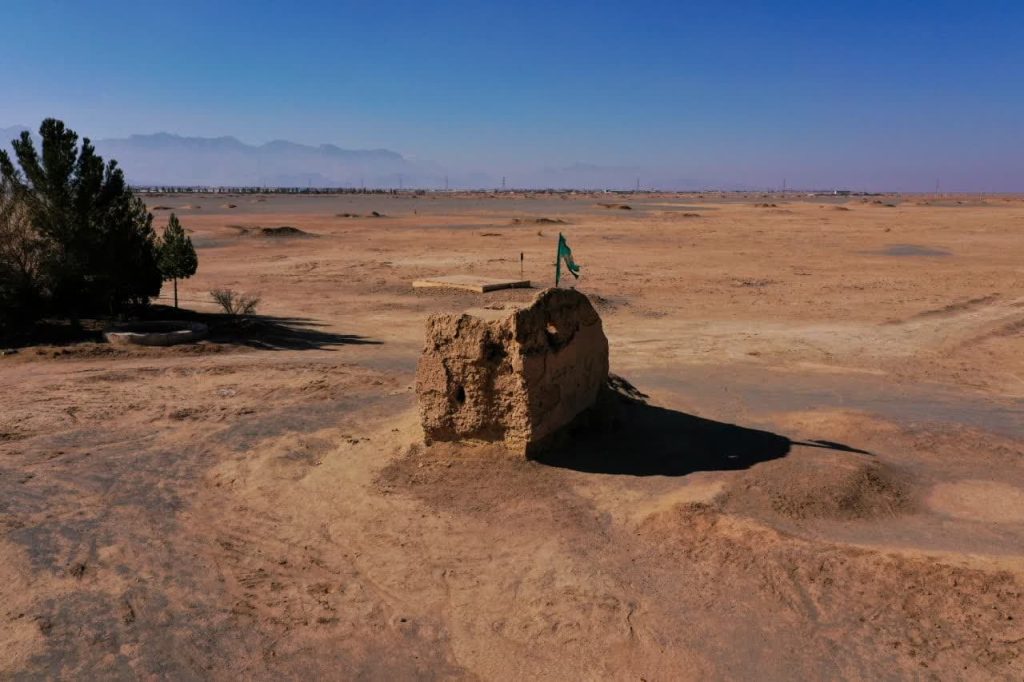
In his book Tārīkh-ī Jadīd-ī Yazd (New History of Yazd), the 9th-century historian, Katib, recounts the tale of the “Well of Forty Maidens” (Chāh-i Chahār Dashtān). According to his narrative, when the threat of an invasion arose, women and children, fearing the enemy forces, fled and threw themselves into a well filled with water near the fields. The enemy troops pursued them in an attempt to capture them. The women, including the wife of Huytib ibn Hani, Ruqayyah bint Nufayl, along with other women and daughters of the companions, sought refuge in the well. When the enemy reached the edge of the well, a warrior named Wahshi stood guard, fighting valiantly to protect them. However, at dawn, Wahshi was martyred on the back of the well, and his grave is said to be there today. Ruqayyah, along with her son Bashir, threw herself into the well, and other women and girls followed suit. By God’s will, the well’s water dried up, though its depth increased from 12 arsh to 50 arsh.
When the enemy entered the well area, they did not find the women. Bandar, a commander in the army of the Magi, peered into the well and immediately lost his eyesight. Katib further notes that today, people visit the site of the well, light wood for a fire, and make wishes, many of which are granted. Some people, intending to make a wish, throw pebbles into the well, and if they hear the sound of a growl from within, their wish is said to be fulfilled. However, Katib emphasizes that throwing stones into the well is highly inappropriate and was forbidden by the esteemed Shams al-Mulk and al-Dīn Muhammad ibn al-Bāfqī. Furthermore, the site is known as a place where the Prophet Khidr (peace be upon him) has been seen multiple times and is considered a gathering place for forty special individuals.
Afshar, Iraj. (1348) Yād-gārhā-yi Yazd: Mo‘arrefī-yi Abniyah-yi Tārikhi va Āthār-yi Bāstānī-yi Khāk-i Yazd. Vol. 1, Tehran: Iranian National Heritage Association.
Jafari, Jafar ibn Muhammad ibn Hassan. (1343) Tārīkh Yazd. Edited by Iraj Afshar. Tehran: Book Translation and Publishing Institute.
Rahimdel Maybodi, Tayebeh. (1389) “Historical Study of the Introduction of Shia Islam in Yazd.” Majalleh-i Ma‘rifat, 19th year, issue 156, pp. 59-68.
Katib, Ahmad ibn Husayn ibn Ali. (1345) Tārīkh Jadīd Yazd. Edited by Iraj Afshar. Tehran: Amir-Kabir Publishers.
Mostofi Bafqi, Muhammad Mufid. (1342) Edited by Iraj Afshar. Asadi Bookstore Publications, issue 5.
Na’ini, Muhammad Jafar ibn Muhammad Hussein. (1353) Jāmi‘ al-Ja‘fari. Edited by Iraj Afshar. Tehran: Iranian National Heritage Association.